Minister of Planning takes part in two sessions on the sidelines of the Global Partnerships Conference in London
[20/05/2026 03:30]
London - Sabanet
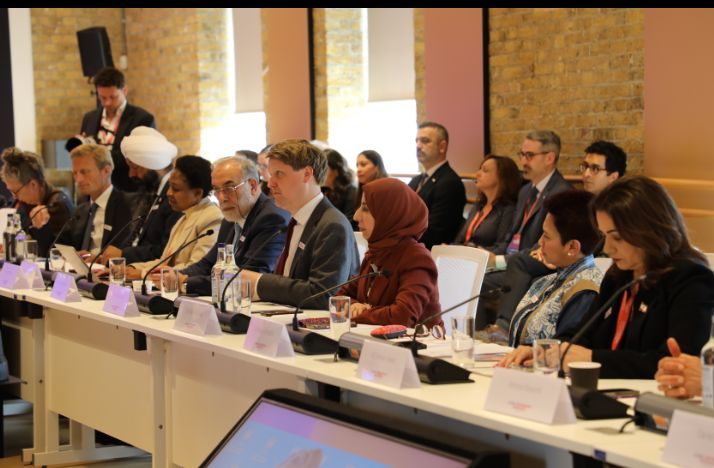
The Minister of Planning and International Cooperation, Dr Afrah Al-Zuba, today participated in a high-level session organised by the United Kingdom in conjunction with the African Development Bank Group. The session was dedicated to discussing the repercussions of the Iran crisis on fertiliser markets and global food security, as well as the required international response, on the sidelines of the Global Partnerships Conference held in London.
The session, attended by the UK’s Under-Secretary of State for Foreign Affairs, Nick Dyer, and the President of the African Development Bank Group, Dr Sidi Ould Tah, alongside a number of African ministers of development and finance, representatives of the Food and Agriculture Organisation (FAO), the World Food Programme, the World Bank and international financial institutions, as well as representatives from the private sector, the structural implications of the crisis on global supply chains for fertilisers, fuel and food, against a backdrop of a 30 per cent decline in global fertiliser trade and a rise in urea prices of more than 30 per cent.
The session also reviewed the growing financial pressures on countries that import their food requirements, and the need for proactive financing mechanisms that intervene before a shock occurs rather than after, emphasising that the current crisis is not an isolated event but part of a phase of recurring shocks that necessitates building structural resilience.
In her remarks, Dr Afrah Al-Zuba emphasised that the Republic of Yemen represents one of the clearest examples of fragile, import-dependent markets, as Yemen imports the bulk of its basic food requirements. She noted that the repercussions of the current crisis are being felt directly in Yemen through prices, explaining that Yemen is facing this crisis.
The Minister of Planning noted that the real gap lies in the timing of the response, and that tools for proactive action and pre-financing are available but often arrive too late. She called for early intervention in the most vulnerable markets and the protection of local agricultural production by ensuring the availability of agricultural inputs and seeds at affordable prices.
The Minister of Planning and International Cooperation also participated in the closed session on humanitarian action, co-chaired by Dr Abdullah Al-Rabeeah, General Supervisor of the King Salman Humanitarian Aid and Relief Centre, and Baroness Jenny Chapman, UK Minister for Development.
The session addressed the protection of civilians and humanitarian workers, in light of escalating violations and declining adherence to the provisions of international humanitarian law, as well as the need for more flexible and predictable funding, the expansion of proactive tools and insurance-based financing mechanisms, and the development of the role of coordinators.
Dr Afrah Al-Zuba reviewed Yemen’s experience over a decade of humanitarian work, emphasising that members of local communities in Yemen are always the first responders. She noted the vital role of Yemeni communities abroad, particularly in the Kingdom of Saudi Arabia, which contribute annual remittances exceeding five billion dollars and bear a significant burden in supporting Yemeni families.
The Minister of Planning and International Cooperation emphasised the importance of strengthening the capacities of national institutions and implementing more organised strategic interventions, coupled with clear exit strategies that enable Yemen to rely on its own institutions in the long term.
Meanwhile, the contributions made during the session, taken as a whole, emphasised the importance of restoring protection to the core of humanitarian work and providing adequate and sustainable funding for it, supporting UN Resident Coordinators and Humanitarian Coordinators in carrying out their duties in the fields of negotiation and humanitarian diplomacy, and ensuring accountability for violations committed against civilians and humanitarian workers.
.jpeg?token=8078738fa50e0ad1e18866d0c42b27c7)
.jpeg?token=78332084da7ed92587853a7ca15677a1)
.jpeg?token=f8a490df57292f471580b5e94b29b4a8)
.jpeg?token=eee629cb029f52b7486362d2b7121b84)
.jpeg?token=51cb0ea45708d943e3d4775453a80548)
.jpeg?token=526dd7c0cf180cb4ee0be008c83cce6f)
.jpeg?token=792d01f7013afa58fdbf6673db984dff)
.jpeg?token=32e9cb29b5f0f683fa8da6fd7251a02d)