Ministry of Planning and UNICEF discuss the 2027–2029 Country Programme Document
[10/06/2026 12:35]
Aden – Saba
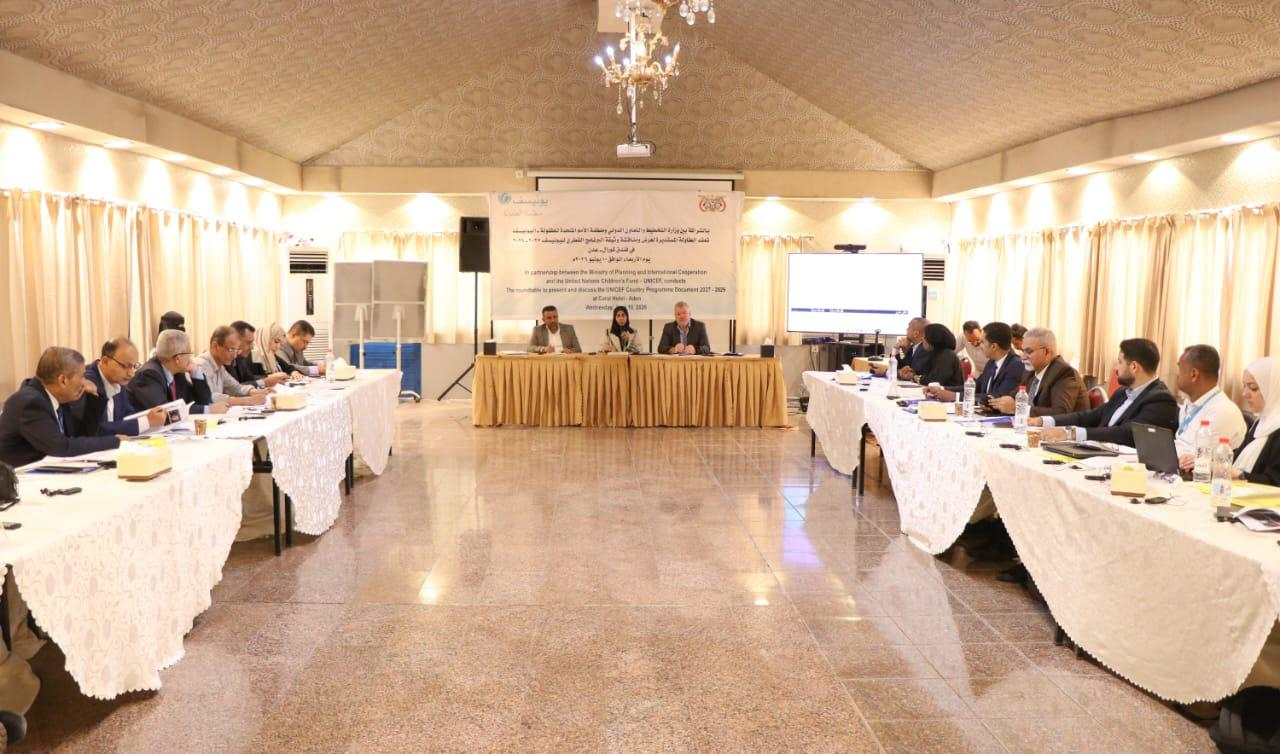
A roundtable held today in the temporary capital, Aden, with the participation of the Ministry of Planning and International Cooperation and the United Nations Children’s Fund (UNICEF), reviewed the UNICEF Country Programme Document for 2027–2029.
The roundtable, attended by a number of deputy ministers, directors-general and specialists from government agencies, discussed the overall vision of the UNICEF Country Programme and its draft for the period 2027–2029, alongside the priorities and needs of national sectors across various development, service and social fields.
The Minister of Planning and International Cooperation, Dr Afrah Al-Zuba, emphasised that the discussion of the UNICEF Country Programme represents an important milestone in shaping a new phase of strategic partnership that moves beyond emergency humanitarian response towards institutional recovery and sustainable development. She praised the pivotal role played by UNICEF in supporting the service and social sectors throughout the various stages and challenges the country has faced.
Minister Al-Zouba called on UNICEF to strengthen the link between humanitarian and development work, and to build an effective model that integrates humanitarian interventions – particularly in the water, education and protection sectors – with national development priorities and state institutions, rather than treating them as parallel tracks.
The Minister of Planning emphasised the importance of fully aligning the Country Programme with national sectoral priorities, and focusing on supporting the establishment and development of national information systems, the formulation of public policies, and the strengthening of institutional governance mechanisms. She noted that accurate data and effective policies form the basis for any successful sectoral planning and the achievement of tangible development outcomes.
Minister Al-Zouba emphasised the need to adopt an approach of on-the-job training and empowerment to build the technical and institutional capacities of government staff, and to enable national institutions to fulfil their roles in leading construction and development efforts. She noted that the Ministry is currently working on preparing a three-year national development plan, based on government sector plans and the priorities of shared needs raised by central and local institutions, thereby contributing to overcoming current challenges and achieving the desired development goals.
For his part, UNICEF’s Resident Representative in Yemen, Peter Honkins, explained that the document serves as a framework for partnership and coordination between the Yemeni government and the United Nations system in supporting sustainable development, and defines UNICEF’s contribution to achieving national priorities during the coming phase.
The UN official noted the organisation’s commitment to drawing on the priorities set by the Yemeni government, as well as the results of multi-indicator cluster surveys and available statistical data, to help identify the most urgent needs and support evidence-based decision-making and planning. He reaffirmed UNICEF’s commitment to continuing its partnership with the Yemeni government and to strengthening development and capacity-building efforts across various sectors.
.jpeg?token=8078738fa50e0ad1e18866d0c42b27c7)
.jpeg?token=78332084da7ed92587853a7ca15677a1)
.jpeg?token=f8a490df57292f471580b5e94b29b4a8)
.jpeg?token=eee629cb029f52b7486362d2b7121b84)
.jpeg?token=51cb0ea45708d943e3d4775453a80548)
.jpeg?token=526dd7c0cf180cb4ee0be008c83cce6f)
.jpeg?token=792d01f7013afa58fdbf6673db984dff)
.jpeg?token=32e9cb29b5f0f683fa8da6fd7251a02d)