Planning Minister Discusses Strengthening Humanitarian Coordination and Supporting the Transition to Sustainable Development with UN Officials
[14/06/2026 01:36]
Aden – Saba:
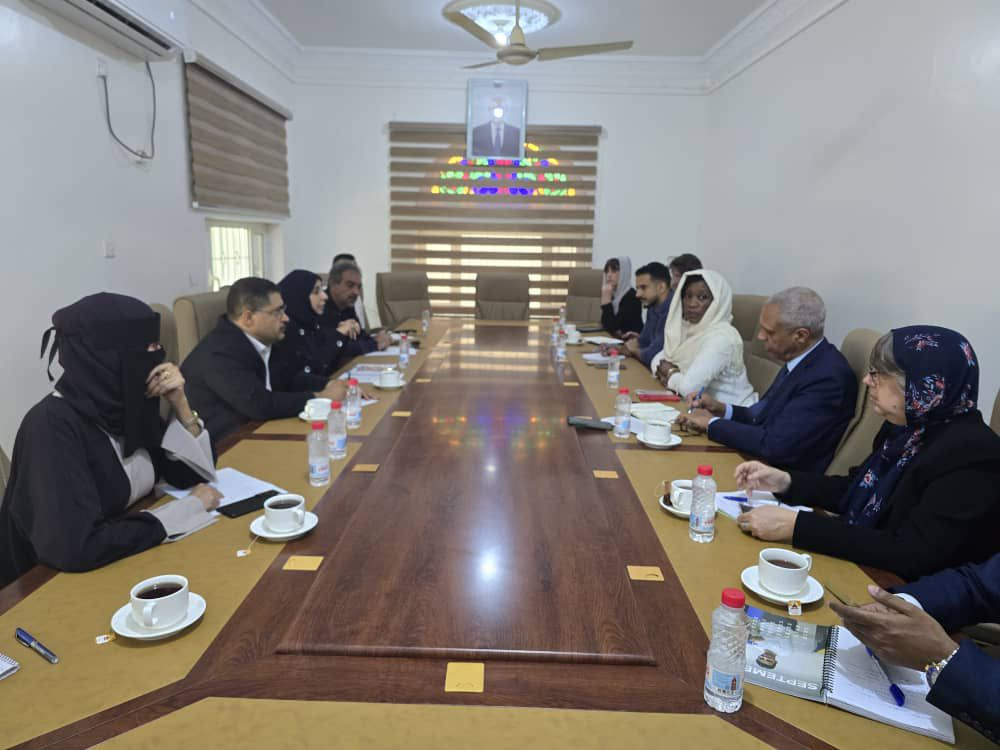
The Minister of Planning and International Cooperation, Dr Afrah Al-Zuba, today discussed in the temporary capital, Aden, with the Director of the Crisis Response Division at the United Nations Office for the Coordination of Humanitarian Affairs (OCHA) and Chair of the Global Emergency Directors Group, Edim Wosorno, the most significant humanitarian developments and the priorities for humanitarian and development work in Yemen.
The meeting addressed a number of issues, foremost among them the importance of strengthening the presence of UN agencies in the temporary capital, Aden, and exchanging data and information relating to humanitarian projects with the relevant government bodies, thereby supporting coordination and follow-up efforts.
During the meeting, Minister Al-Zuba emphasised the importance of strengthening the government’s role as a key partner in the planning, implementation and monitoring of the humanitarian response, ensuring that interventions are aligned with national priorities and the needs of citizens. She stressed the need for a gradual transition from emergency humanitarian response to supporting sustainable development and building the capacity of national institutions.
The Minister of Planning and International Cooperation also emphasised the importance of enhancing transparency in humanitarian coordination mechanisms, and regularly involving the government in discussions on humanitarian priorities, programmes and funding, thereby contributing to improving the efficiency of the response and achieving integration between various interventions. She emphasised that achieving more sustainable results requires a genuine partnership with state institutions and strengthening the integration between humanitarian and development efforts.
For her part, the UN official affirmed the Office for the Coordination of Humanitarian Affairs’ commitment to continuing cooperation and coordination with the Yemeni government and relevant partners, thereby contributing to improving the response to humanitarian needs across Yemen.
In another meeting today, the Minister of Planning and International Cooperation discussed areas of joint cooperation and the programme’s priorities for the coming period with the new Country Director of the World Food Programme in Yemen, El Khadir Daloum.
The two sides addressed a number of issues of mutual interest, including school feeding programmes, promoting local procurement to support the national economy, and the importance of integration and coordination with development programmes and projects implemented in partnership with the World Bank and other donors.
The Minister of Planning welcomed the new Country Director of the World Food Programme in Yemen, wishing him every success in his new role, and commending the vital role played by the Programme in supporting food security and providing humanitarian aid to millions of Yemenis, alongside its contributions in the areas of school feeding and logistics.
Minister Al-Zuba emphasised the importance of strengthening coordination and partnership between the Programme and the Yemeni government, ensuring that interventions are aligned with national priorities and that the aid provided to citizens achieves the greatest possible impact, highlighting the role of the Ministry of Planning and International Cooperation in coordinating international cooperation programmes and monitoring their implementation.
For his part, the WFP Country Director outlined the programme’s key directions and strategies for the coming period, and its plans aimed at strengthening food security and improving livelihoods, in addition to expanding programmes that contribute to building resilience, and the gradual transition from emergency humanitarian response to sustainable development interventions.
Translated with DeepL.com (free version)
.jpeg?token=8078738fa50e0ad1e18866d0c42b27c7)
.jpeg?token=78332084da7ed92587853a7ca15677a1)
.jpeg?token=f8a490df57292f471580b5e94b29b4a8)
.jpeg?token=eee629cb029f52b7486362d2b7121b84)
.jpeg?token=51cb0ea45708d943e3d4775453a80548)
.jpeg?token=526dd7c0cf180cb4ee0be008c83cce6f)
.jpeg?token=792d01f7013afa58fdbf6673db984dff)
.jpeg?token=32e9cb29b5f0f683fa8da6fd7251a02d)