Minister of Planning and International Cooperation discusses humanitarian and development priorities with UN Resident Coordinator
[16/02/2026 02:31]
Aden - Saba
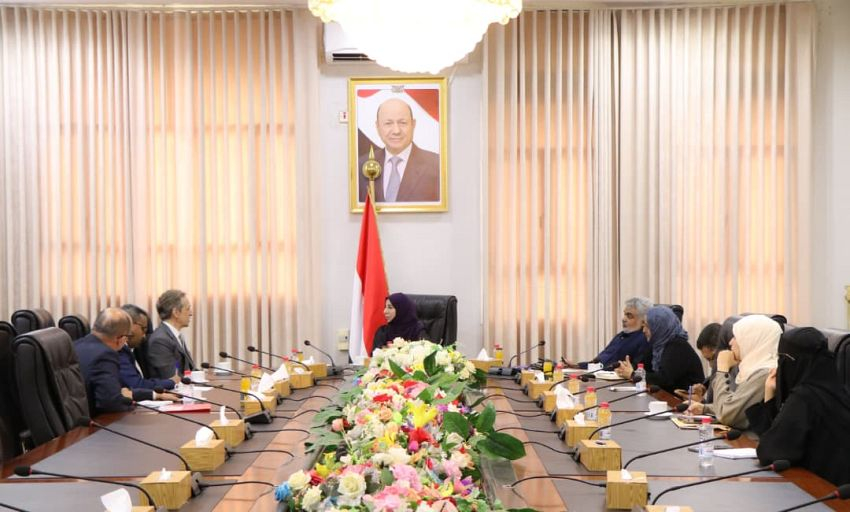
The Minister of Planning and International Cooperation, Dr. Afrah Al-Zuba, discussed today in the temporary capital of Aden with the UN Resident Coordinator and Humanitarian Coordinator in Yemen, Julian Harness, the priorities of the humanitarian and development plan and ways to strengthen joint coordination mechanisms in line with the current changing situation.
The meeting, which was attended by Deputy Minister of Planning and International Cooperation Dr. Nizar Basheeb, Deputy Ministers for International Cooperation Omar Abdulaziz, the Deputy Minister for the Engineering Projects Sector, Minister Al-Sharmani, and the Country Director of the OCHA Office in Yemen, Karen Boon, discussed coordination mechanisms between the government and the United Nations, the activation of the Joint Permanent Coordination Committee, and the importance of aligning humanitarian interventions with national requirements and priorities to meet the needs of all Yemenis throughout the Republic.
Minister Al-Zuba emphasised the importance of the next framework being a joint document based on consultation and full alignment with the government's priorities, reflecting the implementation plans for both tracks, humanitarian and development, and that the Ministry of Planning and International Cooperation should play a central role in coordinating with all ministries and UN organisations to ensure programme integration and avoid duplication.
Minister Al-Zouba pointed out that humanitarian affairs fall within the responsibilities of the government, stressing that the current situation is different from what it was in previous years and requires closer coordination and genuine partnership.
The minister stressed the need for UN agencies, including the UN Development Programme, to submit their plans and programmes in coordination with the Ministry of Planning so that they can be aligned with the required needs, and for sectoral coordination to be carried out through working groups comprising the relevant ministers and competent organisations at the level of recommendations and effective participation in decision-making.
The meeting reviewed ways to address the crisis of declining funding and mobilise the necessary resources to implement priority programmes, and to strengthen the role of donors in supporting early recovery plans, with a focus on vital sectors, foremost among which are health, education, water, sanitation and food security, in addition to economic infrastructure and strengthening the resilience of local communities.
The Minister emphasised the government's keenness to develop joint working mechanisms with United Nations agencies in order to achieve integration between the humanitarian and development tracks and ensure that support is directed towards sustainable projects. She noted the government's orientation towards comprehensive reform plans and the importance of exchanging data and information with international partners, facilitating the work of organisations, including training, and activating the relevant government agencies.
The meeting addressed the issue of detained UN and international organisation staff in Sana'a, with the Minister expressing the government's concern for the safety of humanitarian workers and the importance of ensuring a safe environment for them.
For his part, the UN Resident Coordinator reiterated the UN's commitment to continue supporting the Yemeni government in implementing its humanitarian and development plans, strengthening partnerships with various national entities to ensure that aid reaches those most in need, and achieving a tangible and sustainable impact in improving livelihoods and basic services. He affirmed the United Nations' readiness to expand its programmes in line with the government's priorities and in support of recovery and reconstruction efforts.
.jpeg?token=8078738fa50e0ad1e18866d0c42b27c7)
.jpeg?token=78332084da7ed92587853a7ca15677a1)
.jpeg?token=f8a490df57292f471580b5e94b29b4a8)
.jpeg?token=eee629cb029f52b7486362d2b7121b84)
.jpeg?token=51cb0ea45708d943e3d4775453a80548)
.jpeg?token=526dd7c0cf180cb4ee0be008c83cce6f)
.jpeg?token=792d01f7013afa58fdbf6673db984dff)
.jpeg?token=32e9cb29b5f0f683fa8da6fd7251a02d)