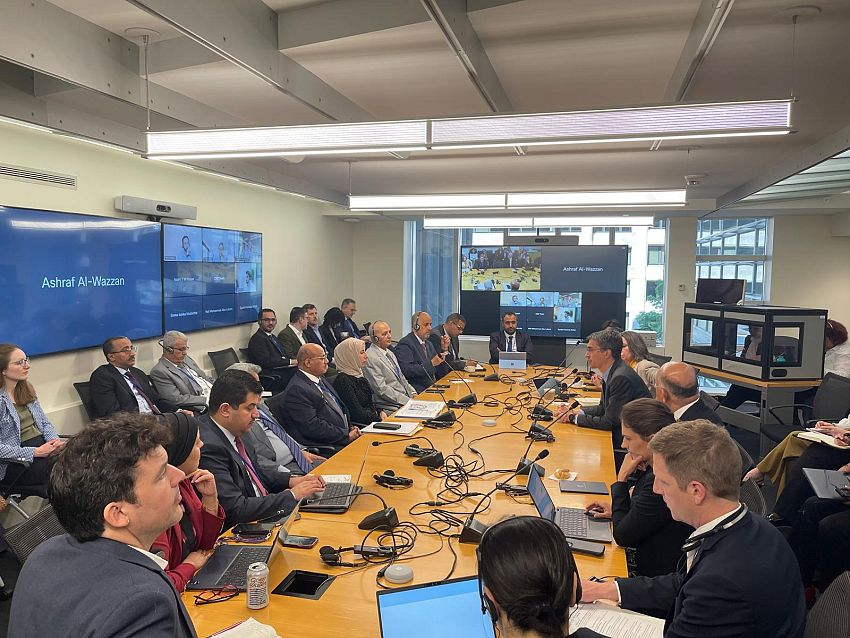
Government delegation discusses key projects for the 2026 financial year with the Qatari leadership of the World Bank Group
[16/04/2026 02:19]
Washington – Saba
The government delegation participating in the World Bank Group’s Spring 2026 meetings
and the International Monetary Fund, today in the US capital, Washington, with the
country leadership of the World Bank Group, the list of upcoming projects for the 2026 financial year
in vital sectors.
The World Bank team reviewed the list of upcoming projects, which includes a three-phase programme to enhance
the resilience of water services in the face of climate change, a project
health, nutrition, water and sanitation, the Cash for Nutrition and Livelihoods project,
the Public Institutions and Systems Modernisation project, and additional funding for the
Emergency Integrated Urban Services project. The International Finance Corporation also reviewed its investments
in Yemen’s private sector, including the development of financing products compliant with
Islamic Sharia to support small and medium-sized enterprises.
The Minister of Planning and International Cooperation, Dr Afrah Al-Zuba, emphasised the importance of
the new Country Partnership Framework responding to the Yemeni government’s priorities in the
National Development Plan, and of it being based on a flexible operational model combining direct government implementation
and third-party arrangements. She stressed the need to include a trade
and trade facilitation project among the list of upcoming projects, supporting the modernisation of customs and
port infrastructure and facilitating the entry of essential goods, as well as a roads project addressing critical
infrastructure priorities and linking economic hubs and governorates.
Dr Al-Zuba called for a gradual transition towards empowering national institutions,
and addressing the issue of fuel financing for hospitals and water stations through an exit strategy
linking them to sustainable energy solutions, whilst strengthening the role of the private sector to serve the agenda
of public-private partnership.
The Governor of the Central Bank of Yemen, Ahmed Ghalib, also emphasised the Bank’s efforts to maintain
monetary stability, manage the exchange rate, promote reforms in the
banking sector, and combat money laundering and terrorist financing, noting the importance of intensifying
support to address the repercussions of the regional crisis on the Yemeni economy.
For his part, Finance Minister Marwan bin Ghanem reaffirmed the government’s commitment to continuing
reforms in public financial management, revenue mobilisation, and debt management.
He He emphasised the importance of technical and financial support from the World Bank to strengthen the resilience of
public finances in the face of current challenges, and the need for close coordination
with the International Monetary Fund in addressing macroeconomic conditions.
For his part, the World Bank’s Country Director noted that the new Country Partnership Framework
will be submitted to the World Bank’s Board of Directors for discussion at the end of May
next month, confirming that there is a significant list of projects currently being prepared with support from the International Development Association
.jpeg?token=432eb00c6c4c3fc0746ad237b5885708)
.jpeg?token=fd9ffa6930fd069aed0817b8ee821ea5)
.jpeg?token=eee629cb029f52b7486362d2b7121b84)
.jpeg?token=51cb0ea45708d943e3d4775453a80548)
.jpeg?token=526dd7c0cf180cb4ee0be008c83cce6f)
.jpeg?token=792d01f7013afa58fdbf6673db984dff)
.jpeg?token=32e9cb29b5f0f683fa8da6fd7251a02d)