Ministers of Water and Planning Discuss Studies on the Aden Desalination Project with World Bank Team
[17/04/2026 05:21]
Washington – Saba
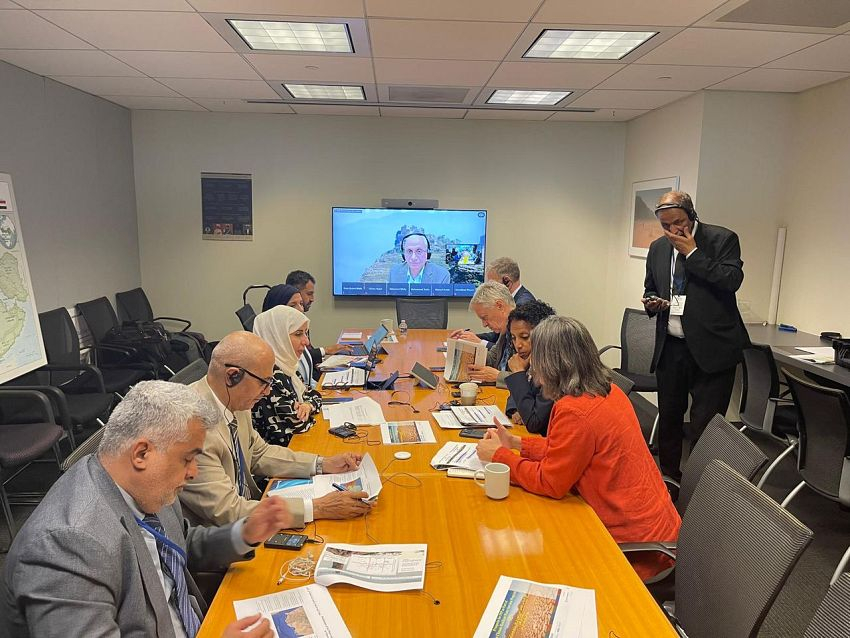
The Minister of Water and Environment, Engineer Tawfiq Al-Sharjabi, and the Minister of Planning and International Cooperation, Yemen’s Governor at the World Bank Group, Dr Afrah Al-Zuba, met today in the US capital, Washington, with the World Bank’s water sector team to discuss enhancing the resilience of water services in the face of climate change and studies for the Aden desalination project.
During the meeting, held on the sidelines of the 2026 Spring Meetings of the World Bank Group and the International Monetary Fund, the Minister of Water and Environment outlined the reality of the water crisis in the city of Aden and the urgent need for desalination projects. She noted that the city relies primarily on the Tuban Delta aquifer, which is experiencing a continuous decline in water levels, alongside an increase in seawater intrusion.
The Minister of Planning and International Cooperation emphasised the importance of the strategic programme in addressing the acute water crisis facing Yemen. She noted that the water sector is a cornerstone of the National Development Plan and the new partnership framework with the World Bank Group, stressing the need to involve the private sector, the International Finance Corporation and international agencies to ensure investment from the earliest stages, in line with the government’s approach to strengthening public-private partnerships.
For its part, the World Bank team presented during the meeting the multi-phase water programme, which is the first of its kind in Yemen and spans ten years. It comprises three main phases, beginning with a first phase focusing on watershed management and water and sanitation services, alongside the piloting of small solar-powered desalination plants in the Aden and Wadi Hajar, followed by a second phase involving the construction of a major seawater desalination plant for the city of Aden, whilst the third phase involves expanding the programme to include new catchment areas, alongside exploring opportunities for additional funding from the Green Climate Fund to support the programme’s phases.
The two sides agreed to begin forming a joint technical committee comprising the Ministries of Water and Environment, Planning and International Cooperation, the local water authority, and the World Bank Group, to prepare for the major desalination plant project and to continue coordination to finalise the requirements for the first phase proposal to be presented to the World Bank’s Board of Directors next May, as well as early preparation for the second phase, including feasibility studies and engaging the private sector and regional and international partners.
Translated with DeepL.com (free version)
.jpeg?token=8078738fa50e0ad1e18866d0c42b27c7)
.jpeg?token=78332084da7ed92587853a7ca15677a1)
.jpeg?token=f8a490df57292f471580b5e94b29b4a8)
.jpeg?token=eee629cb029f52b7486362d2b7121b84)
.jpeg?token=51cb0ea45708d943e3d4775453a80548)
.jpeg?token=526dd7c0cf180cb4ee0be008c83cce6f)
.jpeg?token=792d01f7013afa58fdbf6673db984dff)
.jpeg?token=32e9cb29b5f0f683fa8da6fd7251a02d)