Ministry of Planning and International Cooperation issues policy paper on nutrition improvement options to promote sustainable development in Yemen
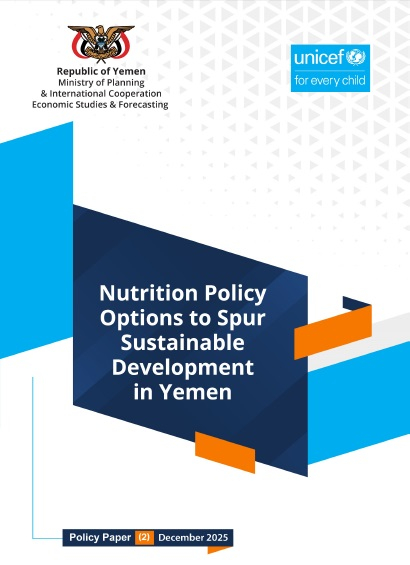
The Ministry of Planning and International Cooperation, in collaboration with UNICEF, has released the second policy paper in its series of analytical publications supporting public policy-making, entitled: ‘Policy Options for Improving Nutrition to Promote Sustainable Development in Yemen.’ This is part of the Ministry's approach to promoting evidence-based planning, guiding multisectoral development interventions, and enhancing the integration of economic, social, and humanitarian dimensions in development pathways. The paper addresses nutrition as a key development entry point closely linked to human development and human capital, particularly the conditions of children and women, and its implications for productivity, social stability, and recovery and development pathways. The paper reviews the current status of nutrition indicators in Yemen, noting that the prevalence of stunting among children under five years of age reached 48.6%, compared to 22.3% and 18% for the global and regional averages, respectively. Wasting has a prevalence rate of 16.9% among children under five, which is much higher than the targets set by the Sustainable Development Goals of 5% in 2025 and 3% by 2030. Meanwhile, the prevalence of anaemia among women aged 15 to 49 was 41%, which is higher than the global and regional averages of 31% and 29%, respectively. The paper also justified nutritional deprivation indicators from a multidimensional poverty perspective, with 57.6% of households suffering from food insecurity and 38.2% of households with children under the age of five suffering from some form of malnutrition. The paper provides an assessment of the policy and institutional environment for the nutrition sector in terms of political and legislative commitment and institutional capacity, as well as an analysis of the most prominent challenges facing nutrition, foremost among which is the decline in the volume of actual humanitarian aid funding, which does not exceed 9% of the funding required to meet nutrition needs for 2025, in addition to governance challenges. In conclusion, the paper proposes a package of short- and medium-term policy options, as well as long-term strategic directions that promote the integration of nutrition into sustainable development pathways.
The ministry emphasised that the publication of this paper supports the development of evidence-based policies and promotes the integration of national efforts and development partnerships, thereby contributing to reducing multidimensional poverty, improving the conditions of children and women, and advancing development efforts in Yemen.
https://drive.google.com/file/d/13otMWhwtZPZwo-vu1mLLClK0ZFpbA8Vy/view?usp=drive_link
.jpeg?token=8078738fa50e0ad1e18866d0c42b27c7)
.jpeg?token=78332084da7ed92587853a7ca15677a1)
.jpeg?token=f8a490df57292f471580b5e94b29b4a8)
.jpeg?token=eee629cb029f52b7486362d2b7121b84)
.jpeg?token=51cb0ea45708d943e3d4775453a80548)
.jpeg?token=526dd7c0cf180cb4ee0be008c83cce6f)
.jpeg?token=792d01f7013afa58fdbf6673db984dff)
.jpeg?token=32e9cb29b5f0f683fa8da6fd7251a02d)