Minister of Planning Discusses Strengthening Partnership and Aligning Interventions with Government Priorities with the International Organisation for Migration
[13/07/2026 02:50]
Aden – Saba News
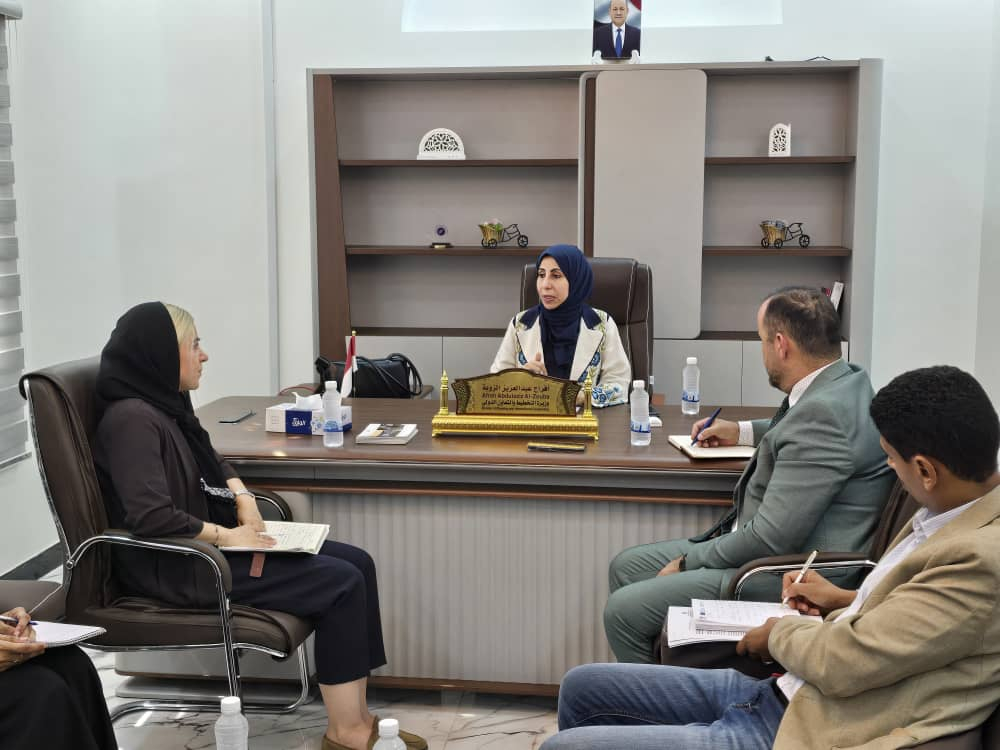
The Minister of Planning and International Cooperation, Dr Afrah Al-Zuba, met today in the temporary capital, Aden, with the Head of the International Organisation for Migration (IOM) Mission in Yemen, Abdul Sattar Issayev, to discuss the organisation’s interventions over the past period and its priority plan for 2026.
The two sides discussed mechanisms to strengthen coordination and partnership between the Ministry and the organisation in implementing programmes and projects in the fields of humanitarian work, recovery, resilience-building and migration management, with a view to supporting the government’s efforts and achieving sustainable development.
Minister Al-Zuba praised the role played by the International Organisation for Migration in Yemen and the level of cooperation with the government, emphasising the importance of directing interventions towards national priorities and strengthening integration between humanitarian efforts and development programmes to achieve a sustainable impact in improving services and supporting the most vulnerable communities.
The Minister of Planning reviewed the latest developments in the preparation of the National Development Plan for the years 2027–2029, noting the importance of aligning the programmes and interventions of development partners with the government’s priorities and strengthening institutional coordination to enhance the efficiency of project implementation and achieve tangible development outcomes.
For his part, the Head of the International Organisation for Migration (IOM) Mission in Yemen explained that the organisation would continue to implement integrated, multi-sectoral interventions in close coordination with the government, including development, rehabilitation and humanitarian response projects. He reaffirmed the organisation’s support for the national government’s priorities, particularly in the areas of improving basic services, promoting stability, and supporting recovery and sustainable development.
At the conclusion of the meeting, both sides emphasised the importance of strengthening institutional coordination and information exchange, and of holding regular meetings to monitor the progress of programmes and projects, in order to ensure that the organisation’s interventions are aligned with national plans and priorities and to achieve the best possible development outcomes.
.jpeg?token=8078738fa50e0ad1e18866d0c42b27c7)
.jpeg?token=78332084da7ed92587853a7ca15677a1)
.jpeg?token=f8a490df57292f471580b5e94b29b4a8)
.jpeg?token=eee629cb029f52b7486362d2b7121b84)
.jpeg?token=51cb0ea45708d943e3d4775453a80548)
.jpeg?token=526dd7c0cf180cb4ee0be008c83cce6f)
.jpeg?token=792d01f7013afa58fdbf6673db984dff)
.jpeg?token=32e9cb29b5f0f683fa8da6fd7251a02d)